FTA 25-78 / HPC TRAINING DATABASE
First steps on Barbora & Karolina.
FTA 25-78 was intentionally simple. Its purpose was to learn how to work on the Barbora and Karolina HPC systems: bash, filesystem, Python execution and the SLURM scheduler. After the basic workflow was mastered, a small iron heat-transfer model generated data and a second script visualized the result.
ProjectFTA 25-78
SystemsBarbora + Karolina
Toolsbash / SLURM / Python
Training modelHeat flow in iron (Fe)
This project was a learning stage rather than a complex scientific simulation: first understand the HPC environment, then run a deliberately small calculation, save its data, and visualize it.
FTA 25-78
8 training and result records · click a row for detail
STAGE HPC onboarding
SYSTEM Barbora / Karolina
MODEL Fe heat flow
#
RECORD / EXERCISE
CATEGORY
BACKEND / STATE
01
FTA2578-001Bash / HPC orientationFirst practical work on Barbora and Karolina: login, filesystem, shell commands and running Python from the command line.
training
Barbora / Karolinacompleted›
FTA2578-001
Bash / HPC orientation
First practical work on Barbora and Karolina: login, filesystem, shell commands and running Python from the command line.
$ ssh user@cluster
$ pwd
$ ls -lah
$ python3 --version
$ hostname
$ mkdir fta-25-78 && cd fta-25-78
02
FTA2578-002First SLURM jobA minimal batch job used to learn how a calculation is submitted, queued and collected on an HPC system.
SLURM
Barbora / Karolinacompleted›
FTA2578-002
First SLURM job
A minimal batch job used to learn how a calculation is submitted, queued and collected on an HPC system.
#!/bin/bash
#SBATCH --job-name=iron-heat
#SBATCH --output=iron-heat.out
#SBATCH --time=00:05:00
#SBATCH --ntasks=1
#SBATCH --cpus-per-task=1
#SBATCH --mem=1G

module load Python
python3 heatflow.py
03
FTA2578-003Iron heat-flow data generatorA deliberately simple Python model generating temperature data for heat transfer through a short iron chain.
Python model
HPCcomputed›
FTA2578-003
Iron heat-flow data generator
A deliberately simple Python model generating temperature data for heat transfer through a short iron chain.
#!/usr/bin/env python3
import numpy as np

k = 80.0          # W m^-1 K^-1, approximate thermal conductivity of iron
alpha = 0.25
steps = 100

T = np.full(4, 20.0)
T[0] = 500.0

history = [T.copy()]
for _ in range(steps):
    n = T.copy()
    n[1:-1] += alpha * (T[:-2] - 2*T[1:-1] + T[2:])
    n[0] = 500.0
    n[-1] += alpha * (T[-2] - T[-1])
    T = n
    history.append(T.copy())

np.savetxt("iron_heatflow.csv", np.array(history), delimiter=",")
print("saved: iron_heatflow.csv")
04
FTA2578-004Result visualization scriptA second script reads the generated CSV data and converts it into a heat-map style visualization.
visualization
Python / matplotlibprocessed›
FTA2578-004
Result visualization script
A second script reads the generated CSV data and converts it into a heat-map style visualization.
#!/usr/bin/env python3
import numpy as np
import matplotlib.pyplot as plt

data = np.loadtxt("iron_heatflow.csv", delimiter=",")

plt.imshow(data.T, aspect="auto", origin="lower")
plt.xlabel("Iteration")
plt.ylabel("Iron segment")
plt.title("Heat transfer in iron")
plt.colorbar(label="Temperature [°C]")
plt.tight_layout()
plt.savefig("iron_heatflow.png", dpi=180)
plt.show()
05
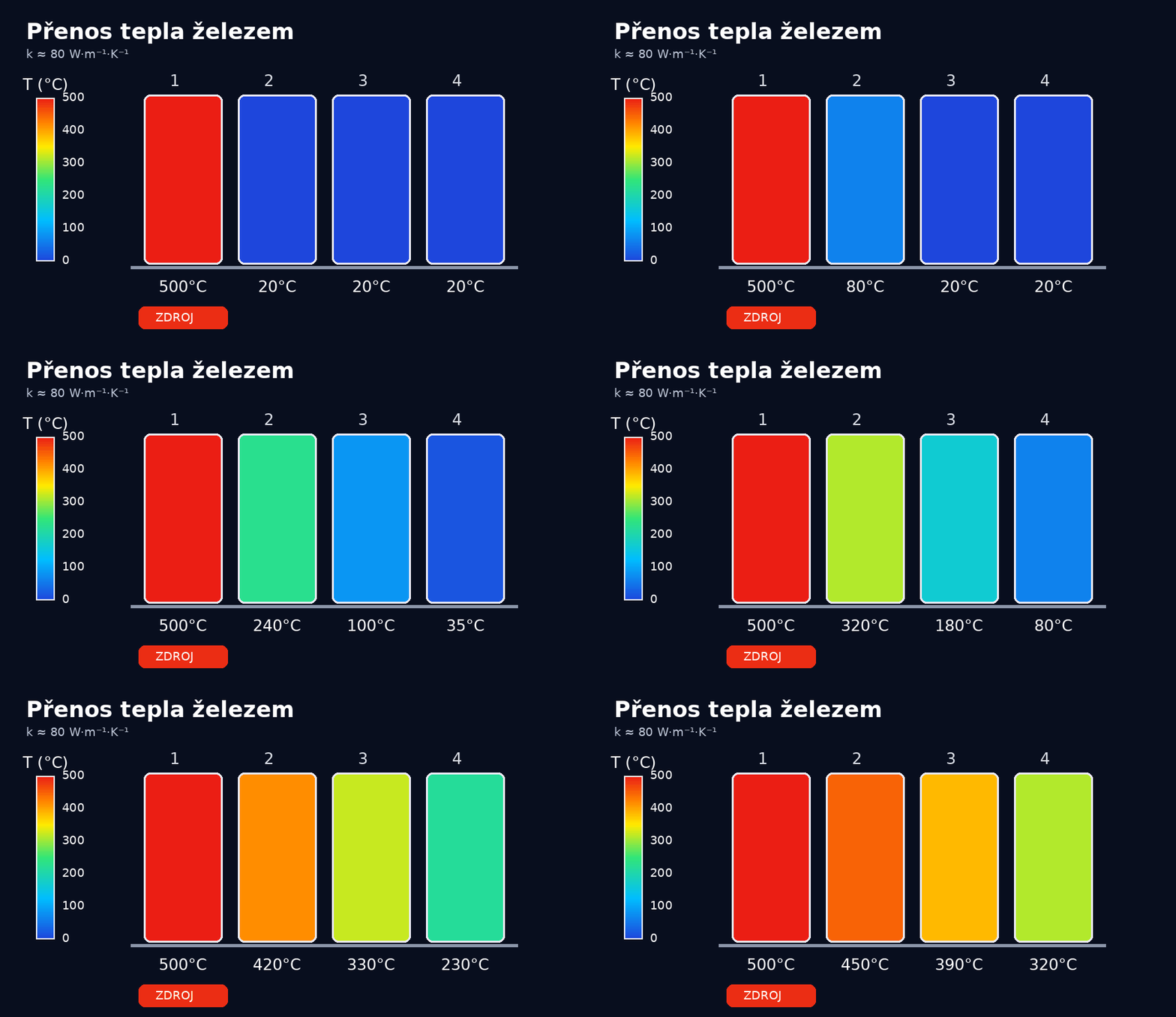
FTA2578-005Four-segment iron modelStatic reference view of the simple iron heat-transfer model, starting from a 500 °C source.
result
HPC outputvisualized›
FTA2578-005
Four-segment iron model
Static reference view of the simple iron heat-transfer model, starting from a 500 °C source.

06
FTA2578-006Animated heat transferAnimated visualization of temperature propagation across the four modeled iron segments.
animation
post-processingvisualized›
FTA2578-006
Animated heat transfer
Animated visualization of temperature propagation across the four modeled iron segments.
07
FTA2578-0072D heat-transfer visualizationA 2D extension used to visualize heat spreading in both directions rather than only along one simple chain.
2D model
HPC / visualizationvisualized›
FTA2578-007
2D heat-transfer visualization
A 2D extension used to visualize heat spreading in both directions rather than only along one simple chain.

08
FTA2578-008From Karolina to VLQContext image connecting the initial HPC training phase with the later VLQ-oriented experimental work.
context
Karolina + VLQcontext›
FTA2578-008
From Karolina to VLQ
Context image connecting the initial HPC training phase with the later VLQ-oriented experimental work.
